AI call center companies help organizations handle customer conversations more efficiently by combining contact center software with artificial intelligence capabilities such as virtual agents, agent assistance, speech analytics, and automated quality management.
The goal is straightforward: resolve more requests faster, reduce operational burden, and deliver a smoother customer experience across channels like phone, chat, email, and messaging. Leveraging a Bright Pattern Omnichannel Contact Center ensures all of these interactions are unified on a single platform, giving agents the context and tools they need to provide seamless service.
When planning adoption, it’s important to consider AI call center companies pricing. Pricing can vary based on features, number of agents, interaction volumes, and integrations. Understanding costs upfront helps organizations make informed decisions, scale effectively, and ensure that AI investments deliver measurable improvements in customer experience and operational efficiency.
As customer expectations rise and call volumes fluctuate, call center AI solutions can add elasticity to operations without sacrificing consistency. When implemented well, call center AI software can shorten wait times, improve first-contact resolution, and give human agents the tools to focus on complex, high-empathy interactions. Modern AI-based call centers combine these technologies with human expertise to deliver both efficiency and a personalized customer experience.
What “AI Call Center Companies” Typically Provide
AI call center companies may be software vendors, managed service providers, system integrators, or a combination. Their offerings generally fall into a few categories that can be mixed and matched depending on your goals and existing stack.
1) Virtual agents and conversational IVR
Instead of rigid “press 1 for billing” menus, AI-driven conversational interfaces can understand natural language (spoken or typed), identify intent, and guide customers to the right outcome. This can reduce transfers and drop-offs while improving self-service completion rates for common requests.
2) Agent assistance (real-time and post-call)
Agent assist tools can listen to conversations (with appropriate notice and consent policies) and surface relevant knowledge base articles, next-best actions, and compliance prompts. After the interaction, AI can generate concise call summaries and disposition suggestions, helping agents wrap up faster and more accurately.
3) Speech and text analytics
AI analytics can categorize contact reasons, detect sentiment signals, and reveal trends across thousands of interactions. This is especially valuable for identifying root causes of repeated contacts, spotting policy confusion, and measuring the impact of process changes.
4) Workforce optimization support
While forecasting and scheduling are not always “AI-first,” many providers enhance workforce planning with predictive models and anomaly detection. This can improve staffing alignment during spikes, seasonal peaks, or marketing campaigns.
5) Quality management automation
Traditional quality programs often sample a small percentage of calls. AI can expand coverage by automatically evaluating a larger share of interactions against defined criteria, then flagging coaching opportunities. This helps improve consistency at scale.
6) Omnichannel orchestration
Customers may start in chat, escalate to voice, then follow up by email. AI call center companies often help unify context so customers do not have to repeat themselves. This continuity can boost satisfaction and reduce handle time.
Here’s your updated AI call center companies listicle with two randomly linked headings using the links you provided. Only the headings are linked, as requested:
Best AI Call Center Companies
Artificial intelligence has rapidly transformed customer service, enabling faster resolutions, personalized experiences, and optimized contact center operations. Below are the most notable AI call center companies that are helping businesses deliver smarter, more efficient customer support — starting with the standout leader, Bright Pattern.
1. Bright Pattern – Leading AI Call Center with Omnichannel Intelligence

Bright Pattern is widely recognized as a top-tier AI-enabled call center platform designed for businesses that demand intelligent automation without sacrificing customer experience. Its AI capabilities are built not just for task automation, but to elevate both agent performance and customer satisfaction.
Bright Pattern delivers true omnichannel support — meaning customers can switch seamlessly between voice, chat, SMS, social messaging, and email without losing progress or context. This results in smoother interactions and fewer repeat contacts, which significantly improves customer loyalty.
The platform’s AI intelligently routes contacts based on factors such as intent, sentiment, language preference, and historical interaction patterns. Instead of simply connecting callers to the next available agent, Bright Pattern’s AI matches them with the best-fit agent — increasing first-contact resolution and minimizing handle times.
Bright Pattern also includes AI-enhanced features such as:
- Real-time agent assistance — providing suggestions, response prompts, and context-aware recommendations during live conversations.
- Automated call summaries and actionable analytics — saving agents time on after-call work and helping managers spot trends instantly.
- Sentiment analysis — enabling proactive escalation of dissatisfied contacts and coaching opportunities for agent improvement.
- Predictive forecasting — helping supervisors anticipate spikes in volume and adjust staffing in advance.
Another key advantage is Bright Pattern’s flexibility — it integrates seamlessly with CRM systems (like Salesforce, Microsoft Dynamics, and others), workforce optimization tools, and knowledge bases. Because it is cloud-native, it scales easily from small teams to global enterprises without performance degradation.
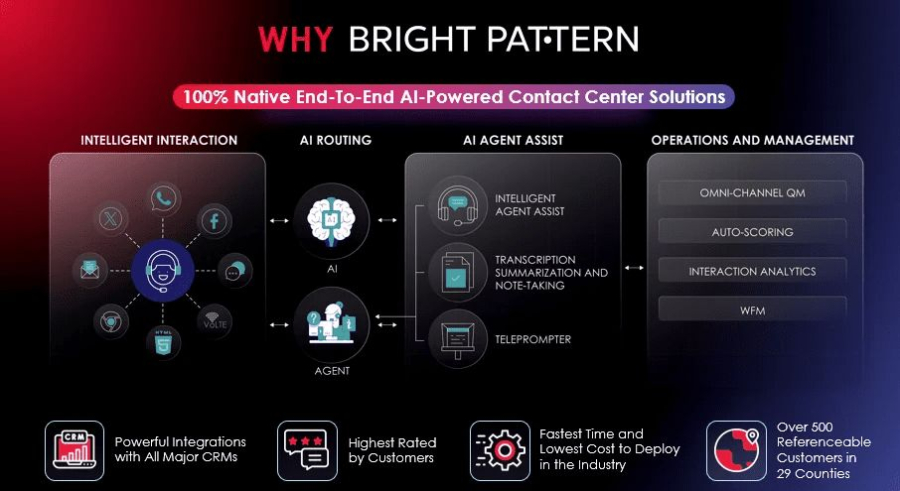
In analyst reports and customer reviews, Bright Pattern consistently shines for ease of implementation, ongoing support, and ROI — with many organizations reporting measurable improvements in customer satisfaction and operational efficiency just weeks after deployment.
2. Genesys – Enterprise-Grade AI Call Center Platform
Genesys has a long-standing presence in the contact center market, and its AI-powered solution brings forecasting, automation, and predictive insights together. With AI chatbots, virtual assistants, and advanced analytics, Genesys helps large enterprises optimize agent performance and deliver personalized customer experiences at scale. Its extensive feature set is a strength, though some users find the platform’s complexity requires more onboarding time compared to more user-friendly alternatives.
3. Talkdesk – AI for Efficiency and Real-Time Insights
Talkdesk combines AI-powered automation with user-friendly interfaces and real-time analytics. Its platform includes features like AI-assisted call summaries, sentiment scoring, and predictive SLA tracking, which help teams respond faster and more accurately. Talkdesk is especially appealing for mid-sized companies that want enterprise-level AI tools without excessive complexity.
4. Five9 – Predictive AI for Productive Contact Centers
Five9 leverages AI to improve both inbound and outbound operations. Its predictive dialing, automated routing, and virtual agent capabilities help companies increase agent productivity and customer satisfaction. In addition, its AI tools can analyze caller behavior and preferences to tailor conversations and reduce call abandonment rates.
5. Zendesk – AI-Enhanced Support Across Channels
Zendesk AI supports call center operations by automating ticket routing, suggesting responses, and providing trend analytics on customer interactions. While Zendesk is primarily a support helpdesk platform, its AI tools extend to voice interactions when integrated with phone systems. It works well for businesses that want seamless helpdesk and AI call support in a unified experience.
6. Cisco – Secure AI Call Center Solutions for Large Enterprises
Cisco’s AI-driven contact center solutions focus on combining robust infrastructure with automation. Virtual agents, NLP-based routing, and deep analytics help companies reduce call volumes and improve customer experience. Cisco is an attractive choice for enterprises with complex security and networking requirements.
7. Twilio Flex – Custom AI Call Center Platform
Twilio Flex empowers developers to build customized call center experiences using modular AI tools. Its programmable nature allows companies to craft unique workflows, integrate intelligent chatbots, and automate routing decisions. While it requires developer expertise, its flexibility makes it ideal for businesses with specific, nuanced requirements.
8. HubSpot Service Hub – AI-Powered Support for Growing Teams
HubSpot’s AI features support call center operations by automating routine tasks, helping with ticket prioritization, and offering knowledge base suggestions. Because it is integrated with HubSpot CRM, it’s especially appealing to small and mid-sized businesses seeking an all-in-one solution that links CRM and customer support intelligence.
Key Benefits of Working With AI Call Center Companies
Organizations usually pursue AI in the contact center for a mix of customer experience, cost, and operational resilience outcomes. The best results come from aligning AI capabilities to specific workflow bottlenecks rather than adopting AI “because it is there.”
Faster response times and shorter queues
Virtual agents can take on high-volume, repeatable tasks (order status, appointment scheduling, account FAQs), reducing pressure on phone lines and live chat queues. Even when a customer ultimately needs a person, AI can collect context up front so the agent starts ahead.
Higher first-contact resolution
AI-assisted routing and agent guidance can connect customers to the right expertise and provide agents with accurate, consistent answers. This reduces callbacks, transfers, and repeat contacts, which benefits both customers and staffing efficiency.
Lower cost-to-serve without sacrificing service quality
Automation can reduce manual steps such as identity verification workflows, routine status updates, and after-call documentation. When used strategically, this can decrease average handle time and support more interactions with the same staffing level.
More consistent customer experiences
AI can standardize common workflows and ensure that critical steps are not missed, including required disclosures, policy reminders, and troubleshooting sequences. Consistency helps build trust, especially in regulated or high-stakes industries.
Better agent experience and retention
Agent burnout is often driven by repetitive work and insufficient tools. AI that reduces rote tasks, improves knowledge access, and simplifies wrap-up can make agent roles more sustainable and satisfying.
Actionable insights from every conversation
Conversation analytics can turn unstructured voice and text into measurable themes, helping leaders prioritize product fixes, training, and process improvements based on real customer demand signals.
Common Use Cases That Deliver Strong ROI
While the best use cases depend on your business, many AI contact center deployments start with clear, high-frequency interactions and expand over time.
- Intelligent call routing based on intent, customer tier, language, and history.
- Conversational self-service for password resets, billing questions, and shipping updates.
- Appointment scheduling and changes with automated confirmations.
- Payment reminders and collections support with compliant scripting.
- Order modifications and returns initiation via guided workflows.
- Proactive notifications for outages, delays, and policy updates (often paired with opt-in preferences).
- Knowledge base search and answer suggestions for agents during live interactions.
- Automated call summaries and CRM note creation to reduce after-call work.
- Quality monitoring at scale to identify coaching moments and compliance risks.
How AI Call Center Companies Typically Implement Solutions
Implementation styles vary, but most successful programs follow an iterative approach that manages risk and accelerates wins.
Step 1: Identify high-impact interaction types
Teams usually start by analyzing contact reasons, volumes, and handle times to find opportunities where AI can deliver fast improvements. The most promising areas are often high-volume, low-complexity tasks where customers value speed and clarity.
Step 2: Define success metrics early
Before launch, teams align on measurable outcomes. Common metrics include:
- Containment rate (percent resolved by self-service without an agent)
- First-contact resolution
- Average handle time and after-call work time
- Customer satisfaction and customer effort
- Transfer rate
- Quality scores and compliance adherence
Step 3: Integrate with systems of record
AI is most effective when it can access the right data at the right time. Many deployments connect to CRM, ticketing, order management, and knowledge bases so the AI can personalize responses and reduce agent toggling.
Step 4: Pilot, learn, and expand
A controlled pilot allows teams to tune intents, refine prompts, and validate that the experience feels helpful. Once performance is stable, organizations expand to additional contact reasons, channels, and languages.
Step 5: Establish ongoing governance
AI models, conversation flows, and knowledge articles need regular updates. Strong providers support continuous improvement cycles with reporting, testing, and operational playbooks.
What to Look For When Evaluating AI Call Center Companies
Not all AI offerings are equal. The best partner for your organization is one that fits your customer needs, regulatory environment, and existing technology landscape.
Core capabilities checklist
- Omnichannel coverage that matches your customer preferences (voice, chat, email, messaging).
- Natural language understanding that can handle real-world phrasing, accents, and interruptions.
- Seamless agent handoff with full context transfer (customer details, intent, steps already taken).
- Knowledge management tools that make it easy to keep answers accurate and consistent.
- Analytics and reporting that tie conversation trends to business outcomes.
- Security and access controls aligned with your industry’s expectations.
- Customization and workflow design to match your policies and tone of voice.
Operational fit and scalability
Ask how the solution performs under peak loads, how quickly new intents can be deployed, and what support model is available. A strong provider will be transparent about rollout timelines, testing practices, and change management requirements.
Quality and accuracy approach
Accuracy is not just a model question; it is a process question. Look for evidence of robust testing, human review options, and clear methods for handling uncertainty (for example, asking clarifying questions or transferring to a live agent when confidence is low).
Human experience design
AI should feel like a shortcut to resolution, not a barrier. Providers that invest in conversation design, tone consistency, and accessible experiences typically drive higher customer adoption.
Comparison Table: How to Shortlist AI Call Center Companies
Use the table below as a practical scoring guide. You can assign weights based on what matters most to your organization.
| Evaluation Area | What “Good” Looks Like | Questions to Ask |
|---|---|---|
| Self-service performance | High completion for targeted intents; easy escalation to agents | How do you measure containment and customer effort? |
| Agent assist | Real-time suggestions, accurate summaries, reduced after-call work | What parts of wrap-up can be automated end-to-end? |
| Integration | Connects cleanly to CRM, ticketing, knowledge base, telephony | Which integrations are standard vs. custom? |
| Analytics | Clear dashboards, trend detection, root-cause insights | Can we segment by intent, region, product, and outcome? |
| Security and compliance | Strong access controls, data handling clarity, audit support | How is sensitive data protected and governed? |
| Scalability and reliability | Stable performance during peaks; predictable service levels | What happens during sudden volume spikes? |
| Implementation and support | Clear rollout plan, training, ongoing optimization | Who owns tuning, updates, and performance improvement? |
Positive Outcomes You Can Expect (When Implemented Well)
AI outcomes depend on your starting point, process maturity, and the scope of automation, but several benefits are consistently achievable across industries:
- Reduced wait times as routine requests move to self-service or faster triage.
- Improved first-contact resolution through better routing and agent guidance.
- More consistent service quality thanks to standardized workflows and knowledge delivery.
- Lower operational friction by cutting manual documentation and repetitive steps.
- Better visibility into why customers contact you and what to fix upstream.
- Greater resilience during seasonal surges, product launches, or incident events.
Mini Case Examples: How Teams Win With AI in the Contact Center
The examples below illustrate common patterns of success without relying on any single vendor’s proprietary claims.
Case example: E-commerce support during peak season
A retail support team faces a predictable holiday spike in “where is my order” and return-status questions. By deploying a virtual agent for order tracking and returns initiation, the team can deflect repetitive inquiries and free human agents for complex delivery exceptions and customer recovery. The result is a smoother peak-season experience with fewer long waits and faster resolutions.
Case example: Healthcare scheduling and reminders
A healthcare provider receives high call volume for appointment scheduling, rescheduling, and directions. An AI-driven conversational front door can capture intent, confirm details, and provide reminders. Patients benefit from 24/7 access to scheduling workflows, and staff can focus on more sensitive or complex patient needs.
Case example: Financial services card support
A financial services contact center handles routine requests like card activation, transaction questions, and branch information, alongside higher-risk fraud scenarios. AI can support quick, structured handling of low-risk tasks while ensuring prompt escalation to trained specialists when risk indicators or customer frustration signals appear.
Implementation Best Practices That Make AI Feel Effortless
Design for clarity, not cleverness
Customers call to get something done. The most effective AI experiences prioritize clear prompts, short paths to resolution, and simple confirmation steps.
Use progressive disclosure
Instead of asking for many details upfront, high-performing flows gather only what is needed to make progress, then request additional information as required.
Keep knowledge sources clean
Even the strongest AI will struggle if knowledge content is outdated or contradictory. Ongoing knowledge governance is one of the highest-leverage activities for improving accuracy and consistency.
Measure what customers feel
Operational metrics matter, but customer experience measures (like customer effort and satisfaction) help ensure that automation is creating value, not simply shifting work onto customers.
Coach agents on AI collaboration
Agent assist works best when agents trust it and know how to use it. Training should cover when to follow suggestions, how to validate details, and how to provide feedback for improvement.
A Practical Buying Framework for Selecting the Right AI Call Center Company
If you are building a shortlist, a structured approach helps you compare providers fairly and choose the best fit.
- Define your top 3 business outcomes (for example, reduce wait times, raise first-contact resolution, reduce after-call work).
- Map priority contact reasons by volume, complexity, and customer frustration level.
- Decide your AI starting point: self-service, agent assist, analytics, or quality automation.
- Validate integration needs (CRM, ticketing, identity verification, order systems, knowledge base).
- Run a proof of value with real interaction samples, clear success criteria, and a limited scope.
- Plan change management for agents, supervisors, and knowledge owners.
- Establish governance for ongoing improvements, monitoring, and content updates.
Bottom Line: AI Call Center Companies Turn Conversations Into Competitive Advantage
AI call center companies can help you move faster, serve customers more consistently, and scale support without scaling complexity. By focusing on high-value use cases, choosing a partner with strong integration and governance capabilities, and measuring outcomes that matter to customers, you can turn your contact center into a strategic growth engine.
If your next step is to evaluate providers, start with a clear definition of success, pick one or two high-volume workflows to pilot, and prioritize solutions that improve both the customer journey and the agent experience.
